A practical framework for building hiring systems that scale with Humans + AI
Why Most ATS Implementations Fail
The problem isn’t your software. It’s the missing operating model.
Not long ago, a client reached out after upgrading their Applicant Tracking System (ATS) to unlock the latest AI capabilities. Instead of finding a faster, smarter hiring process, they found themselves navigating broken workflows, inconsistent reporting, confused hiring managers, and a growing list of administrative headaches. The promise of AI had quickly given way to operational chaos.
As we started digging into the problem, something became clear almost immediately.
The ATS wasn’t broken. The hiring system was.
Like many organizations, they had invested in an enterprise-grade platform before establishing a standardized hiring framework. They expected the software to become the process when, in reality, modern ATS platforms are intentionally designed to be configured around your process.
Whether you’re using Pinpoint, Greenhouse, Lever, iCIMS, Workable, Rippling, Loxo, or another platform entirely, the technology is only as effective as the operating model behind it.
Over the past twenty years, I’ve worked across nearly every corner of Talent Acquisition (TA). I’ve recruited high-volume hourly talent, specialized technical professionals, executives, and leadership teams. I’ve led TA organizations, built recruiting functions from the ground up, implemented ATS platforms, advised technology vendors, and founded businesses dedicated to helping organizations modernize the way they engage talent. Along the way, I’ve worked with or evaluated more than eighty talent, HR, and workforce technology products, and I’ve partnered with organizations implementing hiring systems ranging from fast-growing startups to enterprise environments.
The lessons have remained remarkably consistent throughout that journey:
- Hiring is a system.
- Your ATS is the operating platform.
- AI is the acceleration layer.
Too many organizations are trying to begin at the third step.
Today’s recruiting technology is more powerful than ever. AI can source candidates, summarize interviews, schedule meetings, generate scorecards, surface insights, and automate countless administrative tasks. Those capabilities are transforming TA for the better. But AI doesn’t replace the need for a well-designed hiring process. In fact, it amplifies it. If the underlying system lacks structure, AI simply helps organizations execute a broken process more efficiently.
That’s why I wanted to write this guide.
Consider it the closest thing I can offer to a “cheat code” for organizations looking to build a scalable hiring framework without immediately hiring a consultant. While no article can replace a full operational assessment, this framework represents the foundational operating model I’ve refined through years of implementations, workflow redesigns, process optimization projects, and TA transformation initiatives.
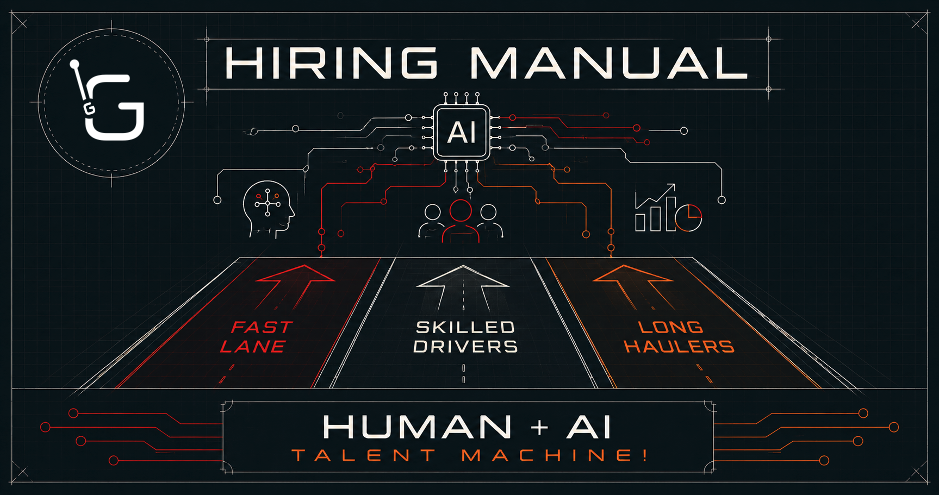
I call it: The 3-Lane Hiring Highway.
It’s intentionally simple, highly adaptable and in my experience, it forms the foundation of a hiring system that can evolve alongside your organization, your technology stack, and the rapidly changing world of AI.
Before We Merge
A quick disclaimer before you start redesigning your ATS
Before we start building highways, let’s establish one important ground rule.
This framework is intentionally standardized.
It is not a custom-built operating model designed specifically for your organization, industry, regulatory environment, hiring volume, or executive team’s unique opinions about how interviews should be conducted. If it were, we’d probably be spending several weeks together mapping workflows, interviewing stakeholders, building a committee, reviewing data, auditing your technology stack, and debating whether six interview rounds are truly necessary.
This article is something different.
Think of it as the equivalent of a trusted mechanic explaining how an engine works or a physician describing the fundamentals of staying healthy. There’s tremendous value in understanding the principles yourself, and for many organizations, these principles will solve a surprising number of problems. However, if the check engine light has been flashing for six months, your transmission sounds questionable, and you’re hoping an AI upgrade will somehow fix all of it, the problem probably deserves deeper diagnostics.
In roughly three-quarters of the environments I’ve supported, this framework fits remarkably well with only modest adjustments. The remaining organizations tend to have unique operating models, regulatory requirements, complex global hiring structures, or highly specialized workflows that require a more tailored approach. Those scenarios absolutely exist but we simply won’t be tackling them in this guide.
That also means I have one request:
Please don’t build an entirely new ATS workflow because one hiring manager wanted a special process for a role they’ll fill once every four years. One-off scenarios are almost always better handled through interview plans, scorecards, assessments, templates, or stage-level configuration rather than introducing another workflow that increases complexity for everyone else.
One of the biggest implementation mistakes I encounter is what I call configuration debt: the gradual accumulation of stages, workflows, automations, and exceptions that all made sense individually but collectively leave the ATS feeling impossible to manage. Complexity has a way of compounding over time, and eventually even simple reporting becomes difficult because every hiring process has evolved into its own unique ecosystem.
This framework is designed to help prevent exactly that.
If you’re willing to start with a standardized foundation, you’ll create a hiring system that’s significantly easier to manage, measure, improve, and eventually enhance with AI-powered capabilities.
If, along the way, you discover your organization needs something more specialized, that’s perfectly normal too.
Just remember that this article is the quick fix. Not the complete treatment plan.
The full diagnosis, implementation strategy, workflow redesign, change management, and long-term optimization work is where experienced practitioners earn their keep. That’s true whether you’re talking about a physician, an automotive technician, or someone helping organizations transform TA.
Fortunately for you, I happen to know someone who enjoys that kind of work.
Now, let’s build your hiring highway.
The 3-Lane Hiring Highway
Why Most organizations only need three standardized workflows
Think about the last time you merged onto a busy interstate.
Every vehicle has the same destination: get safely from Point A to Point B. Yet not every vehicle belongs in the same lane. A semi-truck hauling 80,000 pounds doesn’t drive like a sports car, and neither should an executive search operate like a high-volume customer support role.
Hiring works the same way.
Every candidate ultimately travels toward the same destination (joining your organization) but not every hiring process should move at the same speed, require the same checkpoints, or involve the same level of scrutiny.
Unfortunately, many organizations unintentionally design their ATS as though every position requires the exact same journey. Others swing to the opposite extreme and create dozens of highly customized workflows for every department, business unit, or hiring manager. Before long, reporting becomes fragmented, recruiters spend more time navigating workflows than recruiting, and hiring managers lose confidence in the system.
Sound familiar? You’re in the right place….Neither approach scales particularly well.
After two decades of leading recruiting organizations, implementing ATS platforms, and helping companies modernize their hiring operations, I’ve found that the overwhelming majority of structured hiring can be organized into just three standardized lanes.
The goal isn’t to eliminate flexibility.
The goal is to standardize the foundation.
Once that foundation exists, interview plans, assessments, scorecards, AI tools, automations, and department-specific nuances can all be layered on top without sacrificing consistency, reporting, or candidate experience.
Think of these three lanes as your operating system.
Everything else is configuration.
Fast Lane
High-Velocity Hiring built for speed
If you’ve ever found yourself saying, “We needed this person yesterday,” congratulations—you’ve entered the Fast Lane.
This lane exists for hiring that is predictable, repeatable, and designed for speed. These are often roles that support frontline operations, customer-facing teams, seasonal hiring, or other high-volume recruiting environments where consistency and efficiency matter more than customization.
Typical examples include:
- Customer Support
- Operations and Fulfillment
- Warehouse and Manufacturing
- Retail
- Entry-Level Hiring
- High-Volume Recruiting
- Self-Service Hiring Manager Models
The hidden problem organizations often make in this lane is assuming more process equals better hiring. In reality, the opposite is usually true.
Every additional approval, interview, or workflow stage introduces another opportunity for delay. Candidates lose interest. Hiring managers become frustrated. Recruiters spend more time administering the process than moving talent through it.
For most organizations, a simple three-stage workflow is more than sufficient.
Recommended Workflow
- Applicant Triage
- Hiring Manager Review
- Offer & Onboarding
The triage stage serves as the operational intake point for every applicant.
Recruiters (or hiring managers in self-service environments) can conduct initial reviews, screenings, assessments, hiring events, or other qualification activities before deciding whether the candidate advances.
The important distinction is this:
Candidates remain inside the Applicant Triage stage until they’re genuinely ready for hiring manager review.
That single design decision dramatically simplifies reporting while keeping recruiters focused on moving candidates forward rather than constantly changing workflow stages.
What AI Should Do in the Fast Lane
This is where AI delivers some of its highest return on investment because the administrative workload is repetitive and highly standardized.
Examples include:
- AI-powered sourcing
- Resume matching
- Candidate rediscovery
- Interview scheduling
- Automated communications
- AI-generated interview notes
- Recruiter summaries
- Workflow reminders
Notice what AI isn’t replacing. Recruiters still build relationships. Hiring managers still make hiring decisions. AI simply removes administrative friction so humans can focus on higher-value work.
Typical Characteristics
- Hiring timeline: Less than 30 days
- High hiring volume
- Standardized interviews
- Heavy hiring manager ownership
- Low administrative complexity
When this lane works well, hiring feels almost effortless. When it becomes over-engineered, the Fast Lane quickly becomes the slow lane.
Skilled Drivers
Your Core Hiring Engine
If the Fast Lane keeps the business moving, the Skilled Driver lane keeps the business growing. This is where the majority of professional hiring takes place.
- Software engineers
- Recruiters
- Product managers
- Marketing professionals
- Finance
- Legal
- Operations
The people responsible for building, scaling, and operating the business.
Ironically, this is also where I see the most ATS complexity introduced. Not because these roles require dramatically different workflows, but because organizations gradually customize every department until the hiring process becomes almost impossible to manage.
Instead of creating separate workflows for every function, I recommend standardizing around a five-stage operating model.
Recommended Workflow
- Applicants
- Screening
- Interviewing
- Selection
- Onboarding
On paper, that may appear overly simplistic. In practice, it’s remarkably flexible.
Each stage becomes a container for the activities happening within it. For example:
Screening may include:
- Recruiter Screen
- Portfolio Review
- Skills Assessment
- Phone Interview
Interviewing may include:
- Hiring Manager Interview
- Technical Assessment
- Panel Interview
- Executive Conversation
- Final Team Discussion
Those are sub-steps. Not entirely separate workflows, which is an important distinction.
One of the quickest ways to create reporting chaos is promoting every interview into its own ATS stage. Instead, allow your ATS templates, interview plans, scorecards, and scheduling workflows to handle those details while keeping the overall hiring journey standardized.
This approach produces cleaner reporting, simpler recruiter training, more consistent candidate experiences, and significantly easier AI automation in the future.
What AI Should Do in the Skilled Driver Lane
This is where AI begins acting less like an assistant and more like a co-pilot.
Organizations are increasingly using AI to:
- Generate interview summaries
- Draft scorecards
- Assist with interview feedback
- Recommend candidate matches
- Surface previous applicants
- Automate scheduling
- Analyze hiring funnel performance
- Support workforce planning
- Identify reporting trends
You’ll notice that none of these capabilities replace structured hiring. Instead, they enhance it. Without a standardized workflow underneath, AI has very little consistency to learn from or build on.
Typical Characteristics
- Hiring timeline: 30–60 days
- Moderate hiring volume
- Structured interviews
- Cross-functional collaboration
- Highest reporting requirements
- Greatest opportunity for AI augmentation
This lane becomes the backbone of nearly every TA organization. Configure it well, and everything downstream becomes easier.
Long Haulers
Executive hiring where alignment matters more than speed
Executive hiring plays by a different set of rules. Fortunately, it also represents the smallest percentage of hiring activity for most organizations.
These are the:
- Vice Presidents
- General Managers
- CFOs
- Chief Product Officers
The executives who may influence the direction of an entire company for years to come.
The cost of a poor executive hire often dwarfs the cost of an ATS implementation itself, which is why this lane intentionally trades speed for alignment.
Unlike high-volume hiring, executive searches require greater collaboration, more stakeholder involvement, and significantly more flexibility throughout the process.
Recommended Workflow
- Applications
- Candidate Review
- Initial Screening
- Structured Interview Rounds
- Final Executive Interviews
- Decision & Negotiation
- Onboarding
One stage I intentionally add here is an early Review stage. Executive candidates frequently enter through referrals, networking, retained search firms, or direct outreach rather than traditional applications. Creating a dedicated review point helps ensure exceptional candidates aren’t accidentally buried inside a general applicant queue.
Unlike the other two lanes, movement here isn’t always linear. Candidates may revisit previous discussions. Leadership teams may recalibrate priorities. Compensation negotiations may evolve. New stakeholders may enter the process.
That’s all perfectly normal. The objective isn’t speed. It’s alignment because unlike high-volume hiring, rushing an executive search rarely saves time. More often, it simply delays the inevitable consequences of making the wrong decision.
Typical Characteristics
- Hiring timeline: 60–90+ days
- Low hiring volume
- High stakeholder involvement
- Customized interview plans
- Greater flexibility
- Strategic business impact
Although the workflow becomes more sophisticated, the underlying structure remains remarkably familiar. We haven’t reinvented hiring. We’ve simply introduced additional checkpoints where the risk justifies greater diligence.
Common ATS Mistakes (That I See Over and Over Again)
After supporting implementations across nearly a dozen recruiting organizations and experience with 80+ talent technology platforms, I’ve found that most ATS problems can be traced back to three recurring themes.
Over-Designed Workflows
Every hiring manager believes their role is unique, and sometimes they’re right but most of the time, they’re describing interview content—not workflow architecture.
Resist the temptation to create entirely new workflows for one-off scenarios. Instead, solve those differences through interview plans, scorecards, templates, assessments, and hiring manager guidance.
Your ATS should optimize for repeatability—not exceptions.
Under-Leveraged Reporting
An ATS isn’t simply a workflow engine, it’s also one of your organization’s most valuable operational data sources. When every department follows a different process, reporting becomes fragmented and executive dashboards lose credibility.
Standardized workflows produce standardized data, and standardized data produces better decisions. It’s that simple.
Buying Software Before Building a System
My HR Tech partners aren’t going to love me for this one, but this may be the most common misconception in TA today.
Buying an ATS doesn’t mean you’ve built a hiring system. It means you’ve purchased a highly configurable platform waiting for direction.
Software doesn’t define processes. People do.
The organizations that achieve the greatest success aren’t necessarily using the most expensive ATS. They’re the ones that invest the time to design thoughtful hiring systems first, then configure technology (and increasingly AI) to support that operating model.
The AI Express Lane
Same Highway. Faster Vehicles.
By now, you’ve probably noticed something about the Three-Lane Hiring Highway. Nowhere did I tell you that AI changes the framework.
That’s because it doesn’t.
The highway remains exactly the same. What changes is the speed, efficiency, and intelligence of the vehicles traveling across it.
One of the biggest misconceptions in TA today is that implementing AI somehow replaces the need for a well-designed hiring process. In reality, AI is remarkably good at accelerating work that is already structured, repeatable, and measurable. It is significantly less effective when it’s layered on top of inconsistent workflows, unclear decision-making, or hiring processes that vary wildly from one department to the next.
Putting it another way, if your hiring process resembles rush hour traffic with no painted lanes, adding AI doesn’t solve the congestion. It simply creates more traffic jams– faster.
That may sound overly simplistic, but it’s exactly what I’m seeing across the industry.
Organizations are investing heavily in AI-powered recruiting capabilities while still struggling with foundational process design. They expect the technology to create consistency when, in reality, consistency is what allows AI to perform at its best.
That’s why I believe the evolution of modern TA follows a simple progression.
Process → Systems → AI
- Build the process
- Configure the system
- Then allow AI to accelerate what already works
Skip those first two steps, and you’ll spend significantly more time troubleshooting on a jack stand with the hood-up and hazard lights on than transforming.
Where AI Delivers the Greatest Value
Fortunately, today’s recruiting technology has never been more capable.
The newest generation of AI isn’t replacing recruiters. It’s removing administrative work that has traditionally consumed hours of every recruiter’s week, allowing TA professionals to spend more time doing what humans still do exceptionally well: building relationships, advising hiring managers, evaluating nuance, and making thoughtful hiring decisions.
Across today’s hiring technology landscape, AI is already assisting organizations with:
- AI-powered sourcing and talent discovery
- Resume parsing and candidate matching
- Candidate rediscovery from existing talent pools
- Automated interview scheduling
- AI meeting assistants that capture interview notes
- Interview summaries and recruiter feedback
- Scorecard drafting and completion reminders
- Skills matching and competency analysis
- Workflow automation and task orchestration
- Recruiting analytics and executive dashboards
- Talent intelligence and workforce planning
- Candidate communications and follow-up
- Predictive hiring insights
- Cross-platform automation through emerging technologies like Model Context Protocol (MCP)
If you’ve experimented with any of these tools, you’ve probably noticed something important. None of them replace hiring. They simply make hiring teams more productive. That’s exactly how they should be used.
Recruiters Become Higher-Value Operators
One of the most exciting shifts happening in TA isn’t the automation itself. It’s what automation gives back.
For years, recruiters have been buried under scheduling, note taking, interview coordination, status updates, scorecard reminders, and countless other administrative tasks. While that work is necessary it rarely represented the highest value they could provide to the business.
As those responsibilities become increasingly automated, recruiters have the opportunity to shift their attention toward work that creates significantly greater organizational impact.
That includes:
- Strategic workforce planning
- Hiring manager consulting
- Executive stakeholder alignment
- Talent advisory
- Candidate relationship management
- Employer branding
- Competitive market intelligence
- Diversity strategy
- Executive search
- Change management
- TA transformation
In other words, AI isn’t replacing recruiters. It’s allowing recruiters to spend more time recruiting. That’s a future I can get behind.
AI Still Needs Guardrails
Of course, not every hiring decision should be delegated to an algorithm.
Hiring is ultimately a human decision. Organizations remain responsible for fairness, consistency, transparency, compliance, and sound judgment throughout the hiring process. AI can summarize information, surface patterns, automate repetitive tasks, and assist decision makers, but accountability still belongs to people.
That’s why I consistently recommend viewing AI as a co-pilot rather than an autopilot.
Sure, let AI process information, but be sure to let people exercise judgment.
The best hiring organizations will continue combining structured processes, thoughtful technology, and experienced professionals who understand when human intuition matters most.
The Industry Is Moving Quickly
This isn’t simply my opinion. Industry research points to the same trend.
According to the SHRM – The Role of AI in HR Continues to Expand. Recruiting has become one of the fastest-growing applications of AI within Human Resources. Organizations are increasingly using AI to write job descriptions, source candidates, screen resumes, and streamline applicant communications, with the vast majority of HR professionals reporting measurable improvements in efficiency after adopting these capabilities.
These findings reinforce what many TA teams are already experiencing: AI is proving most valuable when it reduces administrative work rather than replacing human decision-making.
A similar conclusion appears in the latest research from Microsoft. Its Work Trend Index describes the rise of AI agents as an opportunity to expand human capability by allowing intelligent systems to handle repetitive operational work while people focus on strategy, collaboration, creativity, and judgment. Rather than replacing professionals, AI increasingly serves as an extension of the team by handling execution so people can focus on outcomes.
That philosophy mirrors the approach I’ve adopted throughout my consulting work.
Technology should amplify people. Not replace them.
Building Your Human + AI Talent Machine
Where strategy becomes systems and systems become outcomes
By now, you can probably see the pattern. The Three-Lane Hiring Highway isn’t really about workflows. It’s about building a hiring system that people can actually operate.
The highway provides the structure. Your ATS provides the operating platform. AI becomes the acceleration layer that reduces administrative effort, improves visibility, and helps hiring teams spend more time making great hiring decisions instead of managing spreadsheets, chasing interview feedback, or wondering which workflow someone accidentally created three years ago.
When those three pieces come together, recruiting stops feeling like a collection of disconnected tasks and starts operating like an integrated business function. That’s what I mean when I talk about building a Human + AI Talent Machine. Not because AI is replacing recruiters, and not because software suddenly solves every hiring problem, but because people, process, technology, data, and intelligent automation finally begin working together as one coordinated operating model.
That’s where the real transformation begins.
Where Most Organizations Get Stuck
This is also the point where many implementation projects lose momentum.
The excitement of selecting a new ATS has worn off. The contract has been signed. The implementation kickoff meeting is over. Then reality sets in.
Now, someone has to decide how hiring should actually work. That’s where many organizations discover something they weren’t expecting. An ATS isn’t your hiring system. It’s the platform that records your hiring system, which are two very different things.
Modern recruiting platforms are intentionally designed to be flexible because every organization hires differently. The software can accommodate almost any workflow you can imagine, but it won’t tell you which workflow is right for your business.
That’s your job. Or, if you’re working with someone like me, that’s our job together.
Over the years, I’ve found that the organizations struggling the most with implementation almost always share one or more of the same characteristics:
They purchase software without factoring in the cost of implementation, configuration, integration and ongoing maintenance
They begin configuring software before defining the hiring process
Every department wants its own workflow
A lack of documentation or knowledge retention when turnover happens
AI is layered on top of inconsistent hiring practices in hopes that automation will create order
Nobody owns the long-term evolution of the hiring system after implementation
Reporting requirements are treated as an afterthought
If any of this sounds familiar, you’re certainly not alone. In fact, I would argue these are some of the most common (and most preventable) implementation mistakes in TA.
The good news is they’re also fixable.
Transformation Is a Process, Not an Installation
A misunderstanding I see often about ATS implementations is that they’re technology projects but they aren’t. They’re organizational transformation projects that happen to involve technology, which is an important distinction.
Over the past two decades, I’ve refined an eight-stage engagement model grounded in LEAN thinking, Agile delivery principles, and practical TA operations. Rather than treating implementation as a one-time event, the process is designed to reduce risk, create alignment, validate assumptions early, and continuously improve as the organization evolves.
The 8-stage framework found on my website follows a fail-proof process: Assess, Select, Experiment, Roadmap, Implementation, Benchmark, Iterate, and Exit. Each stage builds on the one before it, creating a repeatable delivery model that moves organizations from strategy through execution while ensuring people, process, technology, and AI remain aligned.
Here’s what you’ll notice about the process:
Nowhere does it say “Install software and hope for the best”, because successful implementations don’t happen that way.
Sometimes the assessment uncovers process gaps that need attention before technology is configured. Sometimes the pilot reveals that hiring managers need additional training. Sometimes benchmarking identifies bottlenecks that weren’t obvious during implementation. Sometimes AI features become available six months later and require another round of workflow optimization.
That’s perfectly normal because healthy hiring systems evolve–just like healthy businesses evolve.
Think Like a Mechanic, Not a Magician
People occasionally ask me what it’s like implementing TA technology. I usually compare it to taking your car to a trusted mechanic. Sometimes you just need an oil change, but if the check engine light is on, it’s going to need some deep-dive diagnostic testing.
You may discover the engine has been running with three separate problems for so long that fixing only one of them won’t actually solve anything. Hiring systems work the same way. Occasionally, all an organization needs is a little tuning.
More often, there are underlying process issues that have quietly accumulated over time. It’s not uncommon to see rogue hiring teams jerking out wires like it’s a system problem when in fact, it’s a downstream issue. These are evidenced by additional workflow stages, inconsistent interview practices, reporting gaps, disconnected technologies, or years of well-intentioned “temporary” solutions that gradually became permanent.
You don’t solve those challenges by installing another feature. You solve them by diagnosing the entire system. That’s why I always start with the process. Technology comes second. AI comes third.
When that sequence is reversed, organizations usually get caught doing circles in a roundabout.
The Real Cheat Code
If there’s one idea I hope you remember after reading this guide, it’s that most hiring organizations don’t need dozens of workflows. They need a strong foundation, which oftentimes starts with three standardized hiring lanes.
Everything else like interview plans, assessments, scorecards, automations, AI agents, scheduling tools, integrations, and reporting should be layered on top of that foundation. Not the other way around.
The organizations building the strongest hiring systems aren’t chasing every new feature that enters the market. They’re building operating models that are simple enough to scale, flexible enough to evolve, and structured enough to take full advantage of whatever the next generation of AI brings.
That’s the real cheat code.
Cruising the Hiring Highway
Bringing it all together
By now you should be able to cruise the hiring highway with the radio blasted and the cruise control set on 70 ish… As you do, I hope one thing has become abundantly clear.
This article was never really about Applicant Tracking Systems. It was about building a hiring system that people can actually operate.
Along the way, we’ve covered a standardized framework that I’ve refined through two decades of TA leadership, technology implementations, consulting engagements, and enough workflow redesign projects to know that complexity rarely creates better hiring.
Clarity does.
The Three-Lane Hiring Highway is intentionally simple because simplicity scales.
Most organizations can support the overwhelming majority of their hiring by organizing work into three standardized lanes:
- The Fast Lane for high-volume hiring where speed, consistency, and efficiency are the priorities.
- The Skilled Driver Lane for the structured hiring that powers the core of the business.
- The Long Hauler Lane for executive and highly specialized searches where thoughtful alignment matters more than velocity.
Everything else builds from there:
- Interview plans
- Assessments
- Scorecards
- Automations
- AI assistants
- Scheduling tools
- Analytics
- Integrations
- Candidate communications
- Employer branding
- Referral programs
- University recruiting
- Compliance requirements
- Background checks
- Offer management
Every one of those capabilities strengthens the hiring experience, but none of them replaces the need for a well-designed operating model.
That’s the point. The framework comes first. The technology supports the framework and then AI accelerates the technology. That’s the progression.
Process → Systems → AI.
Remember: Every Highway Still Needs Good Drivers
No framework, article, or software platform can account for every hiring environment.
We intentionally didn’t explore highly regulated industries, global compliance, sophisticated sourcing strategies, employer branding programs, university recruiting, internal mobility, workforce planning, executive succession, or the countless nuances that make every TA organization unique.
That’s not to say those topics aren’t important. Quite the opposite. They’re incredibly important, but they simply build upon the foundation—not replace it.
That’s why I encourage organizations to resist the temptation to solve every hiring challenge by creating another workflow, adding another approval step, or purchasing another piece of technology.
More often than not, the answer isn’t another tool. It’s a better system.
The Cheat Code Was Never the Software
When I first introduced this article, I called it a cheat code. I still believe that’s true.
It doesn’t magically fix every hiring problem overnight, but it gives organizations something many ATS implementations never start with: a practical, standardized foundation for designing hiring workflows that are easier to manage, easier to measure, and significantly easier to improve over time.
Will this framework solve every hiring challenge? Of course not. No single framework can. But if your organization is struggling with inconsistent workflows, confusing reporting, disconnected hiring teams, or trying to introduce AI into an environment that never had a solid operating model in the first place, I genuinely believe this guide will get you remarkably far.
For many organizations, that’s enough to move from chaos to clarity. From reactive hiring to intentional hiring. From disconnected processes to an integrated Human + AI Talent Machine.
When It’s Time to Shift Gears
Eventually, every growing organization reaches a point where a general framework isn’t enough. That’s perfectly normal. Reading about nutrition doesn’t replace a physician, and watching a few videos about engines doesn’t make someone a master mechanic. At some point, experience matters.
That’s where I typically come in.
Sometimes the answer is a simple workflow tune-up. Sometimes it’s selecting the right ATS before making an expensive investment. Other times it’s redesigning an entire TA operating model, integrating new technologies, or helping leadership teams prepare for AI transformation. Every organization is different because every organization starts from a different place.
My goal with this guide wasn’t to solve every hiring challenge you’ll ever face. It was to give you a practical framework that can get most organizations 70–80% of the way there. Think of it as a standardized operating model that brings order to the chaos and creates a foundation you can continue building on as your business grows.
If this guide helped you think differently about your hiring function, then it accomplished exactly what I hoped it would. And if your hiring highway could use another set of experienced eyes behind the wheel, I’d be happy to help you map the road ahead.
Because the future of hiring won’t belong to the organizations with the most technology.
It’ll belong to the ones with the best operating systems.
- Build the process
- Configure the system
- Let AI accelerate the journey
That’s how you build a Human + AI Talent Machine.
Written by: Gannyn Lough
Human + AI Talent Machine!
Email for service or inquiries → human@gannyn.com