If you thought change management was difficult during the digital transformation era, just wait until you cross the workforce planning threshold of the AI era.
Planning tomorrow’s workforce is beginning to feel like performing a live magic act in front of Penn & Teller while hoping they don’t call out every illusion before the trick is finished.
One thing is certain: if you’re still planning your workforce like it’s 2018, you’re about to lose a game of organizational three-card monte. The rules have changed, the cards are moving faster than ever, and most organizations don’t even realize they’re playing a completely different game.
For decades, workforce planning revolved around a relatively simple question: How many people do we need?
That question served organizations well when business cycles were predictable, technology evolved gradually, and job descriptions remained relevant for years. Today, product roadmaps change quarterly, AI capabilities evolve weekly, and entirely new job categories are emerging before organizations have figured out how to manage the last wave of transformation.
The old strategy of hiring for headcount is becoming less about building organizational capability and more like seeing how low you can limbo under the next budget reduction.
The AI era demands a different mindset.
Instead of planning around people alone, leaders must begin planning around outcomes. Workforce strategies now need to account for continuous product innovation, seasonal demand, emerging technologies, specialized expertise, shifting business priorities, and a level of uncertainty that simply didn’t exist a few years ago. The organizations that thrive won’t necessarily be the ones with the largest workforces—they’ll be the ones capable of assembling the right capabilities at exactly the right moment.
If you can read the room like David Copperfield reads an audience, there’s an incredible opportunity waiting on the other side. Organizations that embrace workforce agility can position themselves at the forefront of innovation, attract world-class talent, and build a competitive advantage that’s incredibly difficult to replicate.
Those that don’t?
Well, let’s just say they’ll make headcount disappear faster than David Blaine can make a deck of cards vanish.
Throughout my career leading talent acquisition, workforce transformation, and HR technology initiatives, I’ve found myself returning to the same conclusion: The future of workforce planning isn’t primarily a recruiting problem. It’s a business strategy problem.
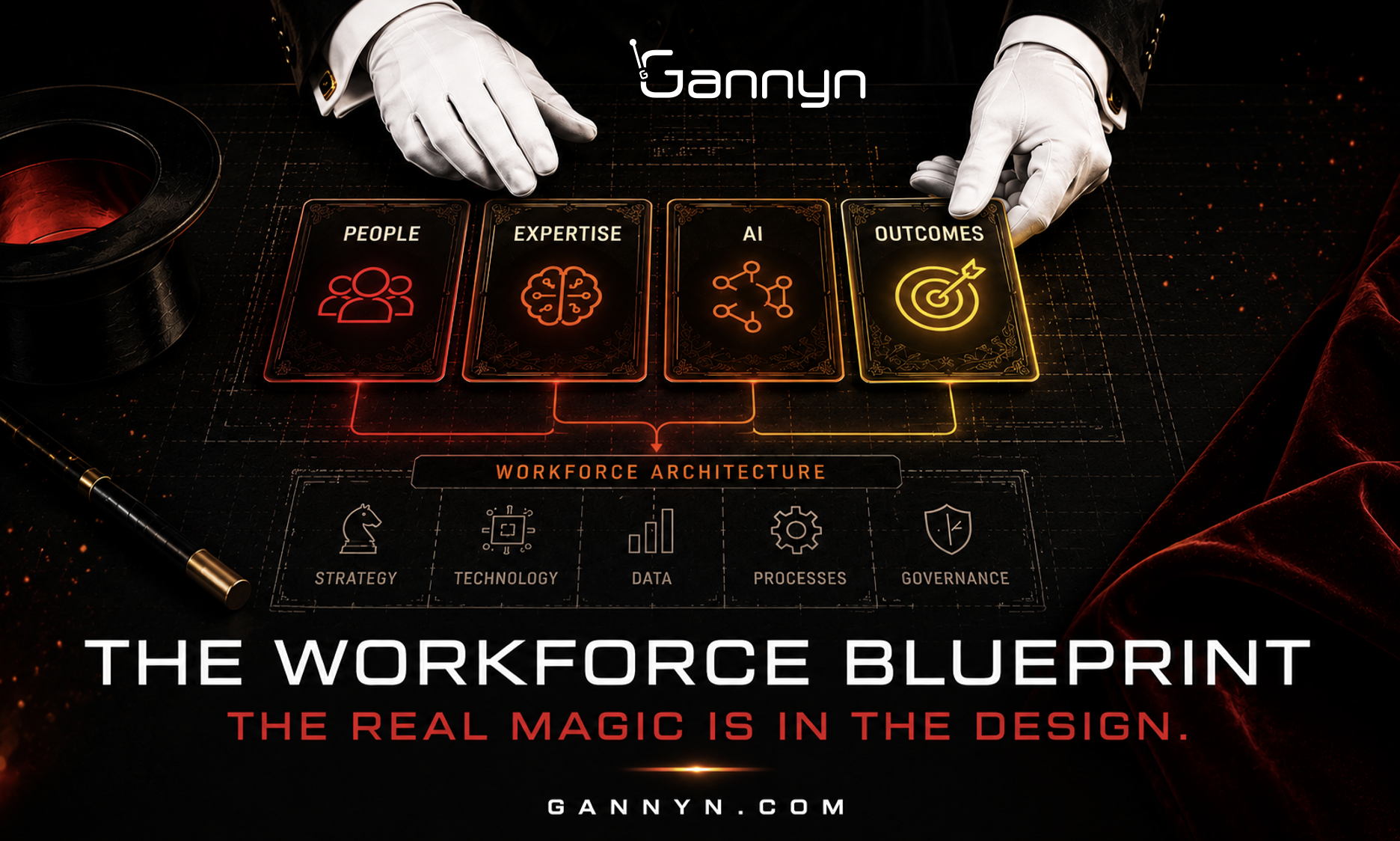
More specifically, it’s about intentionally designing the right combination of permanent employees, independent expertise, and artificial intelligence into a workforce that’s built to adapt instead of react.
In this article, we’ll explore five ideas shaping what I believe is the future of workforce planning:
- Why traditional workforce planning is solving yesterday’s problems
- Why independent operators have become the missing workforce agility layer
- Why AI should be treated as an organizational experiment before it becomes a permanent capability
- How these forces converge into a new model for workforce planning
- What leaders can do today to prepare for what’s next
Like every great magic show, the audience only sees what happens on stage. The real work happens behind the curtain.
The organizations that master workforce planning in the AI era won’t rely on illusions or wishful thinking. They’ll redesign the stage itself—building a workforce capable of evolving just as quickly as the technology transforming it.
Traditional Workforce Planning Was Designed for Yesterday’s Economy
For decades, workforce planning followed a relatively predictable formula.
Organizations forecast demand, approved headcount, opened requisitions, hired full-time employees, and supplemented with temporary staff or contractors when necessary. That model made sense in an era where technology evolved incrementally, product roadmaps stretched over years, and organizational structures remained relatively stable.
That era is over.
If you’re still planning your workforce like it’s 2018, you’re walking into the AI era like a tourist betting on the shell game outside Fisherman’s Wharf. You may think you know which shell the ball is under, but the game has already changed.
Today’s business environment moves faster than annual planning cycles can accommodate.
Product releases happen continuously. AI capabilities evolve weekly. Customer expectations shift overnight. Entire functions are being redesigned while organizations are still trying to fill requisitions approved six months ago.
Workforce planning can no longer be an exercise in forecasting headcount. It has become an exercise in designing organizational adaptability, which is where I believe many organizations are making their biggest mistake.
For years, workforce planning revolved around three familiar categories:
- Full-time employees
- Temporary & contract workers
- Outsourcing & consulting partners
That framework worked when contingent labor existed primarily to solve staffing shortages, seasonal demand, or temporary backfills. Today’s workforce looks very different.
The rise of highly specialized independent consultants has fundamentally changed what workforce flexibility can look like. Many of today’s consultants aren’t searching for permanent employment or hoping their contract converts into a full-time role. They’re architects, transformation leaders, AI specialists, engineers, product experts, recruiters, and fractional executives who have intentionally built businesses around their expertise.
That’s a very different workforce than the contract labor model many organizations still plan around.
Instead of asking, “Who can temporarily fill this seat?” organizations should increasingly be asking, “Who is best equipped to deliver this outcome?”
Research supports this broader shift. The World Economic Forum projects significant disruption to workforce skills over the next five years as AI continues reshaping work, while organizations increasingly move toward more dynamic, skills-based workforce strategies.
Workforce planning is no longer simply about forecasting people—it’s about forecasting capabilities. (WEF Future of Jobs Report 2025)
None of this means full-time employees are becoming obsolete.
Quite the opposite.
Every organization still needs a strong core workforce to own culture, customer relationships, institutional knowledge, governance, and long-term operations. Builders still need maintainers. Visionaries still need operators.
What changes is where organizations choose to create permanence.
Instead of asking:
How many people do we need?
Leaders should begin asking:
- What outcomes are we trying to achieve?
- Which capabilities should remain permanent?
- Where will flexibility create competitive advantage?
- Which initiatives are experimental?
Those questions produce very different workforce strategies than simply filling approved headcount.
One of my favorite sayings from my years in technology consulting is, “don’t force a square peg into a round hole”.
Workforce planning has become much the same. Even the world’s greatest magician couldn’t convince an audience that a hexagon fits neatly inside a circle. The last thing any executive wants from their HR organization is an illusionist.
Workforce planning should never rely on sleight of hand, optimistic assumptions, or hoping reality eventually catches up to the spreadsheet. Transparency, integrity, and thoughtful planning have never mattered more.
The organizations that thrive won’t be the ones with the biggest hiring budgets. They’ll be the ones that stop planning for headcount and start planning for outcomes.
The Independent Workforce Is the Missing Agility Layer
If traditional workforce planning asks, “How many people should we hire?”
Modern workforce planning asks a much more strategic question:
“What’s the best way to achieve this outcome?”
That subtle shift changes everything.
For nearly a decade, I’ve been researching and building around what I believe is one of the biggest workforce shifts since the commercialization of the Internet: the rise of the highly skilled independent workforce.
I don’t advocate for this model simply because I’ve built businesses around it.
I advocate for it because I’ve watched it solve problems traditional hiring models continue to struggle with—especially across technology, transformation, and now AI.
Ironically, Big Tech helped create this workforce. After years of aggressive hiring followed by repeated layoffs, thousands of experienced architects, engineering leaders, recruiters, designers, product managers, and transformation specialists made a different decision. Rather than climbing another corporate ladder, they built businesses around their expertise.
Today, many of the best operators in the industry choose independence. Not because they couldn’t find employment, but because they can create greater impact while designing careers on their own terms.
I explored this trend further in the HireScale Activated July 2026 Newsletter on how recurring technology layoffs accelerated talent mobility and reshaped the future of work.
This is where many workforce planning conversations go off course. Organizations still tend to group independent consultants together with temporary staffing and contract labor. That comparison is becoming increasingly outdated.
Independent operators represent an entirely different category of workforce. They’re fractional executives, AI architects, transformation consultants, technical specialists, and subject matter experts engaged to solve defined business problems—not simply occupy open seats.
You don’t hire an independent operator. You engage one and an engagement starts with an outcome instead of a job description. Success is measured by business impact instead of annual performance reviews. The relationship is built around expertise, ownership, and delivery—not organizational hierarchy.
Examples include:
- Instead of hiring another recruiter, engage a talent consultant to lead a twenty-person engineering, GTM, CX, or other strategic hiring initiative.
- Instead of hiring another full-time HR leader, engage a workforce transformation consultant to redesign your People function, operating model, and technology ecosystem.
- Instead of opening another AI requisition, engage an AI architect to validate an MVP before deciding whether the capability belongs inside the organization permanently.
- Instead of hiring a principal or director-level employee to build an entirely new function, engage an experienced consultant to design, launch, and refine it. Once the model is proven, leverage that same consultant to help recruit, mentor, and transition the capability to a permanent leader.
This approach significantly reduces the risk of employer brand damage, cultural disruption, premature hiring decisions, and the all-too-familiar cycle of restructuring and layoffs that follows when organizations commit to permanent headcount before the work has proven itself.
In other words, intentionally build a layer of workforce agility around your highest-risk, highest-uncertainty initiatives. Think of independent operators as an embedded consulting layer that provides specialized expertise where it’s needed most.
The work becomes the product. The expert becomes the differentiator. The organization gains agility without sacrificing quality, ownership, or continuity. Rather than overcommitting to assumptions, leaders can validate ideas, build repeatable processes, transfer knowledge, and scale with confidence.
Independent operators also bring assets that traditional hiring rarely accounts for:
- Proven methodologies
- Established professional networks
- Their own equipment, tools, and technology
- Repeatable frameworks and playbooks
- Years of accumulated domain expertise
You’re often engaging an entire business capability—not simply another individual contributor.
Like any great magician, the goal isn’t to convince the audience that the impossible happened. It’s to make exceptional execution look effortless because every move was intentionally designed long before the curtain ever rose.
The Workforce Agility Model
This is where I believe workforce planning is heading.
According to MBO Partners’ State of Independence Report, the number of highly skilled independent professionals continues to grow as experienced executives, consultants, engineers, architects, and specialists choose independent businesses over traditional employment. This isn’t simply the evolution of contract labor. It’s the emergence of a distinct workforce layer built around expertise, flexibility, and outcomes.
Exactly what that mix looks like will vary by organization. Workforce planning should never become another magic trick where executives pick a card and hope they guessed correctly. Instead, I recommend thinking about workforce design through what I call the Workforce Agility Model.
Rather than asking,
“How many employees should we hire?”
Ask,
“How much workforce agility does this organization need?”
As a strategic planning framework, I generally recommend:
- Enterprise organizations: Build toward roughly one-third of workforce capacity through an agility layer of outcome-based independent expertise.
- Growth-stage companies: Expand that agility layer as transformation initiatives and product velocity increase.
- Early-stage startups: It’s not unreasonable for as much as two-thirds of work to be delivered by independent operators while products, markets, and operating models are still being validated.
These aren’t industry benchmarks (at least not yet). They’re my recommendations based on more than twenty years designing talent systems and nearly a decade researching independent workforce models.
Don’t get distracted by the percentages. They’re simply a planning tool. The real objective is balance, cultural integrity, optimal efficiency and generating results. Organizations should intentionally design a workforce agility layer that expands and contracts with demand while preserving a strong core of employees responsible for culture, governance, customer relationships, and long-term operational excellence.
It’s also important to distinguish this model from traditional contingent workforce programs. Temporary workers, staffing solutions, and traditional contract labor will continue to have a role, particularly for organizations that need additional capacity for operational, transactional, or short-term workforce needs where more simple work is performed. These models were designed around solving labor gaps.
Independent operators represent the next evolution of workforce flexibility. They are highly skilled professionals who provide organizations with access to specialized expertise, strategic capabilities, and proven experience without requiring permanent headcount. Rather than serving as a temporary replacement for an employee, independent operators are engaged as embedded experts who help organizations execute critical initiatives, navigate transformation, and solve complex business challenges.
This is the shift from flexible labor to flexible expertise. Independents allow companies to proactively bring in the right capabilities at the right moment, embed that expertise directly into their teams, and adapt their workforce as business priorities evolve.
Like every great magic act, the audience only sees what’s happening center stage. The real secret is everything happening behind the curtain.
Modern workforce planning works the same way. The organizations creating the greatest competitive advantage won’t be performing workforce magic tricks. They’ll be intentionally designing the stage before the show ever begins.
The next question, then, isn’t whether independent talent belongs in your workforce strategy. It’s what happens when artificial intelligence changes the equation yet again.
AI Turns Workforce Planning Into an Experiment
Unless you’ve been hiding up a magician’s sleeve, you’ve probably heard the predictions. AI is replacing jobs. AI is creating jobs. AI will transform every industry. AI is overhyped.
The reality is that every one of those statements contains some degree of truth, which is exactly what makes workforce planning in the AI era so challenging.
If the defining characteristic of the last decade was digital transformation, the defining characteristic of this decade will be experimentation. Large Language Models did not simply introduce another productivity tool. They fundamentally changed the information layer of the Internet, creating a ripple effect that is now moving through every function, workflow, and job architecture inside the enterprise.
History provides an important lesson.
The early Internet did not eliminate work. It transformed it. Entire industries disappeared while entirely new categories of work emerged. The organizations that succeeded were not the ones that predicted every outcome perfectly. They were the ones that adapted faster, experimented earlier, and built the capabilities required for an uncertain future.
The AI era requires the same mindset.
Research from Microsoft, Stanford’s Human-Centered AI Institute, and McKinsey consistently points toward a similar conclusion: organizations achieve the greatest value when humans and AI work together rather than independently.
AI can process information, automate repetitive tasks, analyze large amounts of data, accelerate content creation, and generate ideas at remarkable speed. Humans continue to provide judgment, creativity, context, relationships, leadership, ethics, and accountability.
The future of work is not AI versus people. It is people amplified by AI. This distinction creates a significant challenge for workforce planners.
Many AI-related roles today exist in what I would classify as the highly experimental category. If a job title includes terms like AI, transformation, architect, strategist, innovation, emerging technology, principal or Head of, there is a strong possibility the organization is still discovering what success actually looks like.
That is not a weakness. That is the natural process of innovation.
The mistake organizations make is assuming every emerging capability requires permanent headcount before the work has proven its long-term value. Instead, leaders should adopt what I call the Prove It Principle.
Before creating permanent roles, prove that the work deserves to exist.
To do so, organizations should ask:
- Can this initiative demonstrate measurable business value?
- Can the process be repeated consistently?
- Can the capability be documented and operationalized?
- Can internal teams maintain and scale the work?
- Has the organization learned enough to justify permanent investment?
Only after those questions are answered should leaders determine what belongs inside the permanent workforce.
This approach reduces risk while allowing organizations to move quickly, while reinforcing one of the oldest lessons from the technology industry: Builders are not always maintainers.
The architect who designs and implements your AI platform may not be the person best positioned to operate that platform years later. The consultant who creates an AI-enabled recruiting workflow may not be the person managing that workflow once it becomes part of normal operations. The engineer who builds your first AI product capability may not be the person maintaining version ten. Innovation and operations require different skills, different motivations, and often different people.
Yet organizations continue hiring builders with the expectation that they will naturally become long-term operators. When that transition fails, leaders often interpret it as a talent problem. More often, it is a workforce planning problem.
The better approach is intentional knowledge transfer. Organizations should leverage experienced builders to create, mentor, document, and embed best practices alongside internal teams. Then, as capabilities mature, ownership can transition to employees responsible for maintaining and improving those systems.
This preserves institutional knowledge without forcing every experiment into permanent headcount. This shift also creates one of the biggest opportunities for HR and Talent leaders in decades.
For years, People functions have faced pressure to reduce costs, automate processes, and prove their strategic value. At the same time, Talent leaders often have something few other functions possess: a complete understanding of how work happens across the organization.
The best People leaders are no longer simply operators, coordinators or recruiters. They are workforce architects. They are HR technology strategists. They are organizational designers. They are change leaders. Increasingly, they are becoming AI facilitators who help organizations redesign work rather than simply fill jobs.
Especially, do not underestimate the role of Talent leaders in this transition. In many organizations, they are becoming the closest thing to professional magicians. Not because they create illusions, but because they orchestrate incredibly complex organizational change behind the scenes and make transformation appear seamless when done correctly.
Of course, AI adoption also creates legitimate concerns. AI is already contributing to workforce reductions across technology and corporate functions as organizations automate repetitive work and restructure operations. At the same time, entirely new categories of work are emerging around AI governance, implementation, security, infrastructure, product development, and business transformation.
The World Economic Forum projects significant disruption to existing roles alongside continued growth in technology-enabled positions. Workforce planning is no longer about preserving every existing job. It is about preparing organizations and people for the work that comes next. (WEF Future of Jobs and AI)
This is why transparency becomes a competitive advantage. Organizations that communicate openly, invest in workforce development, experiment thoughtfully, and intentionally design work will build trust even during periods of uncertainty.
Those that chase every AI trend without a workforce strategy risk confusing illusion with innovation. Eventually, the trick wears off, the curtain opens, and poor workforce planning is exposed for everyone to see.
Magic is not chaos. The greatest illusionists practice thousands of times before stepping onto the stage. Every movement is intentional. Every transition is planned. Every outcome is designed long before the audience ever sees the performance.
Workforce planning in the AI era deserves the same discipline.
The organizations that thrive will not be the ones performing the flashiest AI tricks. They will be the ones mastering the craft behind the curtain by combining permanent employees, independent expertise, and artificial intelligence into a workforce designed not just for today’s business, but for whatever comes next.
The Future Workforce Requires a New Kind of Magic
When this article began, I compared workforce planning in the AI era to performing a live magic act in front of Penn & Teller.
At first glance, that feels impossible.
Technology changes too quickly. The predictions conflict with one another. The rules seem to shift before organizations have finished adapting to the last change. But great magic has never been about the illusion alone. The audience sees what happens on stage. They do not see the preparation, the systems, the practice, and the strategy happening behind the curtain.
Workforce planning in the AI era works the same way.
The organizations that succeed will not be the ones that predict every disruption perfectly. They will be the ones that build the flexibility, infrastructure, and decision-making capability to adapt regardless of what comes next.
For decades, workforce planning was built around one fundamental question: How many people do we need?
That question created successful organizations and built incredible careers.
But the future requires a different question:
What outcomes do we need to achieve, and what combination of people, expertise, and technology will help us deliver them?
That is the foundation of workforce agility.
Traditional employees will continue to serve as the foundation of great organizations. They provide culture, ownership, institutional knowledge, and long-term operational excellence.
Independent operators will provide specialized expertise, flexibility, and the ability to rapidly scale capabilities when organizations need them most.
Artificial intelligence will accelerate productivity, reshape workflows, and create entirely new opportunities that we are only beginning to understand.
The future will not belong to one workforce model. It will belong to organizations that understand how to strategically combine all three.
The magic is not choosing between humans, independent talent, or AI. The magic is understanding how they work together.
Like every great illusion, successful workforce transformation is not about creating something from nothing. It is about understanding the resources available, designing the right system, and intentionally creating the outcome before the curtain goes up.
The best magicians do not rely on luck. They prepare, practice, understand their audience, and anticipate what comes next.
Workforce leaders must do the same.
The AI era will reward organizations that approach workforce planning with curiosity, transparency, and experimentation. The companies that thrive will not be the ones pretending they have every answer. They will be the ones willing to test, learn, adapt, and continuously redesign how work gets done.
The organizations that don’t?
They risk turning workforce strategy into a disappearing act while watching critical skills, employee trust, and competitive advantage vanish right in front of them.
Throughout my career, I have focused on one mission: helping organizations rethink how work gets done by connecting people, processes, and technology in smarter ways.
Through Gannyn.com, I partner with organizations navigating workforce transformation, AI adoption, talent acquisition strategy, HR technology, and organizational design. Through HireScale, I’m helping build the infrastructure for what I believe comes next—a modern engagement platform where organizations can access specialized independent expertise through outcome-based work instead of workforce models built exclusively around permanent headcount.
I don’t believe the future of work will be shaped by simply writing about it. Real progress comes from building. That’s why I continue investing my time in developing products, services, research, and communities designed to help leaders navigate this transition with greater confidence. The conversation is important, but the infrastructure that enables it is what ultimately moves the industry forward.
The future of work won’t be created by one company, one technology, or one individual. It will emerge through experimentation, collaboration, and the willingness to challenge assumptions that are either incomplete or no longer serve us.
I’m always open to opportunities to contribute to leadership forums, executive roundtables, podcasts, conferences, and industry discussions centered on workforce strategy, AI, HR technology, and the future of work. Whether you’re redesigning your talent strategy, exploring workforce agility, evaluating AI, or simply trying to make sense of what’s changing, I’d welcome the opportunity to continue the conversation.
The future workforce is already taking the stage.
The organizations that succeed won’t be the ones performing the flashiest tricks. They’ll be the ones that quietly mastered the craft behind the curtain to design a workforce that’s adaptable, intentional, and ready for whatever comes next.
Because in the end, the real magic was never the illusion. It was the preparation.